-

Harry Hayfield wrote a new post on the site The Weather of Wales (and other parts of the United Kingdom) 7 years, 11 months ago
And the reason for that is a jet stream that’s been taking a massive holiday for instead of crossing the Atlantic as it usually does, it’s been taking (perhaps a well earned rest) in Iceland and Greenland for the […]

-

Kevin Shaw wrote a new post on the site West Rockville MD Weather 7 years, 11 months ago
Monday was a cooler and cloudy day, with early morning rain (0.50″) falling, at times quite heavy (5.88″/hour max rain rate @ 0225) temperatures starting out in the upper 50s in the early AM but only rising into […]

-

Cathie Ursu wrote a new post on the site Mid Michigan Weather 7 years, 11 months ago
Today won’t be as comfortable as yesterday with higher humidity and temperatures. Monday was absolutely gorgeous with highs in the upper 70s, light winds, and very low humidity. It was one of those days when y […]

-
William Brantley wrote a new post on the site Jackson, TN's Climate Summary 7 years, 11 months ago
Here is Monday – June 11, 2018`s – Historical Climate Summary !
Lowest Barometric Pressure : 29.85″ at 8 p.m.
Highest Barometric Pressure : 29.94″ at 9, 10 a.m.Lowest Relative Humidity : 52% at 3, 4 p.m […]

-
Kevin Shaw wrote a new post on the site West Rockville MD Weather 7 years, 11 months ago
Sunday was a cooler, cloudy, damp but not wet day with temperatures starting out in the upper 60s in the early AM but only rising into the mid 70s by mid-afternoon before they started to drop again after a cold […]

-
Cathie Ursu wrote a new post on the site Mid Michigan Weather 7 years, 11 months ago
This morning is starting out with a lot of sun and breezy conditions after a wet weekend. Our highs should also be closer to normal than what we have had recently. We received 0.80″ of rain Saturday and into ea […]

-
William Brantley wrote a new post on the site Jackson, TN's Climate Summary 7 years, 11 months ago
Lowest Barometric Pressure : 29.87″ at 4 – 6 p.m.
Highest Barometric Pressure : 30.00″ at 9, 10 a.m.Lowest Relative Humidity : 46% at 3 p.m.
Highest Relative Humidity : 97% at 6 a.m.Lowest Dew Point Temp […]
-
Kevin Shaw wrote a new post on the site West Rockville MD Weather 7 years, 11 months ago
Saturday was a warmer, more humid, mostly cloudy/hazy day with temperatures starting out in the upper 60s in the early AM and rising into the mid 80s by mid-afternoon. Clouds dominated the skies, though the sun […]

-
Cathie Ursu wrote a new post on the site Mid Michigan Weather 7 years, 11 months ago
Today’s forecast called for a partly cloudy day, now that has changed. I’m really getting tired of rain and I hope that the entire summer isn’t like this. We received a total of 0.80″ from yesterday’s showers a […]

-

Karl Bonner wrote a new post on the site Karl's Weather Discussions 7 years, 11 months ago
What a fun weather day for June! In the Portland Metro area there were heavy thunderstorms with dime-sized hail in places, and even reports of a minor tornado in East Vancouver. Here in The Dalles though, the big […]
-
Karl Bonner wrote a new post on the site Karl Bonner's Weather Blog 7 years, 11 months ago
What a fun weather day for June! In the Portland Metro area there were heavy thunderstorms with dime-sized hail in places, and even reports of a minor tornado in East Vancouver. Here in The Dalles though, the big […]

-

Awesome post Karl! A couple questions:
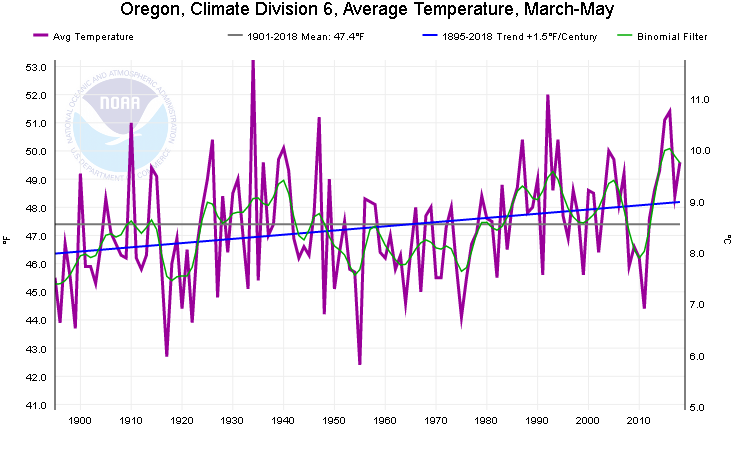
1.) Any idea why the springs have become so amplified as of late? Maybe it could be because we’ve had some pretty big El Nino/La Nina swings, and the Neutral years we’ve had have been quite variable. 2007-2008 and 2010-2011 were both very cool springs and were moderate/strong La Ninas… I remember this because I’m a skier and the ski season lasted a long time! The graph also shows 2009-2010 (which was an El Nino) having a cool spring, which is interesting.
The most anomalous years are actually usually weak ENSO or Neutral years (2014-2015 and 2016-2017 are great examples), and many of our recent Neutral years have been very anomalous indeed.
2.) How did you get the 98% for global warming? Seems like a good estimate (I’d go a little higher personally, like 99 or 99.5, but that’s just an off-the-cuff guess).
Also, it would be interesting to find the correlation coefficient between average March/May rainfall and temperature. This can be easily compiled manually by fetching data from NOAA’s NOW data and then putting it into Excel.
-
1. I’m guessing that springtime amplification may have something to do with the jet stream. Remember, one supposed side-effect of a rapidly warming climate, is that the jet can get bent out of its “normal” shape when the global temperature is steady. That would mean more pronounced cool and warm anomalies – at least relative to the decadal temperature trend. (Not the 30- or 100-year averages, of course!)
2. I’m just using the number 98% as a metaphor for “It’s pretty damn obvious that it’s gettin’ warmer!” I haven’t actually looked at the future simulations/distributions myself. But the data over the past half century is telling enough.
3. While I haven’t done any R-squared ops for temperature vs. precipitation, I DO know that a lot of super-cool springs haven’t been exceptionally wet. (Spring 2011 was an exception.) My guess is that you need the somewhat warmer, muggier airmasses of the central Pacific if you want really heavy rainfall in the spring. The deep cold troughs out of Western Canada are just a little too crisp to soak us. (Kind of like how really heavy fall rains can occur in a mild ‘Pineapple Express’ pattern)
-
-
Charlie Phillips wrote a new post on the site Charlie's Weather 7 years, 11 months ago
Our 4th day of storm chasing (5/31/2018) was a much-needed off day. After driving all the way from Albuquerque to the Texas Panhandle to catch some supercells on Memorial Day and seeing fantastic mesocyclones and […]

-

Hoping the days ahead bring more good weather for you! Mmmm, butter and eggs.
We had quite a variety of weather yesterday here in the Portland/Vancouver area. More rain than in the last 2 months and hail. I had hail up to 1/4” in the late morning, then possibly another round at noontime but I wasn’t home to observe it.
Snowing at Timberline this morning (4” as if 5 A.M.!).
-
-
William Brantley wrote a new post on the site Jackson, TN's Climate Summary 7 years, 11 months ago
Here is Saturday – June 9, 2018`s – Complete Climate Summary !
Lowest Barometric Pressure : 29.96″ at 7 p.m.
Highest Barometric Pressure : 30.11″ at 9, 10 a.m.Lowest Relative Humidity : 44% at 3 p.m […]
-
Kevin Shaw wrote a new post on the site West Rockville MD Weather 7 years, 11 months ago
Friday was a warmer and more humid, partly cloudy/hazy day with temperatures starting out in the lower 60s in the early AM and rising into the lower mid 80s by mid-afternoon. Fair weather cumulus dotted much of […]

-
Cathie Ursu wrote a new post on the site Mid Michigan Weather 7 years, 11 months ago
It was raining when I got up this morning and continues to do so. There was 0.31″ in my gauge at 9 AM, and it has rained continuously since then. I was going to finish planting my flowers but I guess that w […]

-
William Brantley wrote a new post on the site Jackson, TN's Climate Summary 7 years, 11 months ago
Here is Friday – June 8, 2018`s – Historical Climate Summary !
Lowest Barometric Pressure : 30.05″ at 3 a.m., 6, 7 p.m.
Highest Barometric Pressure : 30.14″ at 10 a.m.Lowest Relative Humidity : 40% at 5 p […]
-
Jeff Taylor wrote a new post on the site Maryland Climate and Weather 7 years, 11 months ago
May of 2018 was the wettest ever recorded for Maryland as the Statewide average of 7.68” surpassed the previous record of 7.31”. The month actually started off quite dry through most of the first half (except for […]

-
Great summary Jeff! I have been really busy with all sorts of activities, including getting used to my new rollator walker I got with Marty’s help a week ago. I hope to get all the revision edits together and post the Ellicott City floods on WT sometime this weekend. Will you be able to then slightly modify your May Maryland report to refer to my WT article after publication ? BTW, I was surprised by the 53″ of cover at Timberline the other day – they certainly have a better place to measure the snow than the parking lot – where I saw a mostly snow-free parking lot (not just the paved, plowed part).
-
Thanks, Kevin! Absolutely, I’ll link to your summary of the Ellicott City article, Kevin. Just let me know when you’ve posted it and I’ll grab the web link.
-
Thanks for posting the link to my article on the Ellicott City flooding. I hope to add to it sometime as more information comes in and I get a chance to.
-
-
Kevin Shaw wrote a new post on the site West Rockville MD Weather 7 years, 11 months ago
Thursday was another pleasant, partly cloudy day with comfortable temperatures and dew points. Temperatures started out in the upper 50s in the early AM and rose into the upper 70s by mid-afternoon. Fair weather […]

-
Cathie Ursu wrote a new post on the site Mid Michigan Weather 7 years, 11 months ago
Wow! It’s hard to believe that the longest day of the year is just two weeks away. This year is flying by and the fact that winter didn’t end for us until mid April is probably the reason. This is the la […]
-
William Brantley wrote a new post on the site Jackson, TN's Climate Summary 7 years, 11 months ago
Here is Thursday – June 7, 2018`s – Historical Climate Summary !
Lowest Barometric Pressure : 29.95″ at 2 a.m.
Highest Barometric Pressure : 30.06″ at 9 a.m. – 12 p.m., 11, 11:59 p.m.Lowest Relative Hum […]
- Load More



Thanks for your post Harry. I just love the weather maps your government produces. Such clearly drawn and labelled isobars! And great collaboration between the surface map and the radar overlay! I shared your post with a friend of mine over in Norway, esp. since I believe your map does show a bit of the Scandanavian coast. I am trying to get him to join us here, but that seems so difficult as all my “recruiting” efforts to get more on Weather Together have not been very successful. Keep posting those great maps, Harry and keep us updated on the weather “across the pond”. Thanks!
That might surprise you to know this but that is NOT an official UK weather authority map. That is a map produced by the WXcharts.eu website and is actually several number of times better than anything the Met Office can produce and incidentally, their maps of Norway are way better than anything that Norway can produce either.
I shall certainly try my best which is why I have bought in recent weeks a digital / analogue max / min thermometer, a rain guage and a anemometer in order to make my own observations when we move home on Monday to the village of Llanrhystud (52° 18′ 21.8″ North, 4° 8′ 35.77″ West at an altitude of 20m ASL) however this does have one small drawback and that is I have no idea what the internet signal is like. I am hoping to find out before Monday, but in case I don’t, I will e-mail Nathan my new postal address before I move, so that he can send me a letter and we can keep in touch that way)
Thanks Harry for your great reply update. Good luck in your move to Llanrhystud (what language is that BTW?) and I hope I can help you set up your weather records. I am working with Nathan on that. Amazing about the source of the maps not being from the government! I will have to tell my Norwegian friend about that website!! He may not know about it. Good luck with your future internet signal, hope it comes in for you! Stay in touch here on WT if at all possible. Thanks so much!
Llanrhystud is written in the Welsh language and translates as “Church of” (llan) “St. Rhystud” who was the Bishop of Carleon-on-Usk in Monmouthshire and an immigrant from Letavia. The house that we are moving to has the most perfect north facing wall, a garden (with lots of open spaces) for the rain guage and having bought a wind guage as well, I am all set up
Thanks for the explanation on the Welsh name of your new town. Will you be placing your new thermometer behind your north facing wall? Even though it is north-facing, the thermometer still needs to be sheltered in some sort of radiation shield. I assume your rain gauge will be giving you readings in metric units. Here is a link to start with on recording your daily observations http://www.k12science.org/curriculum/weatherproj/Introductory_Activity_Lessons/lesson3collecting_weather_data/
Good luck with your move! I hope you can continue to report your progress with a good internet connection. Cheerio, Kevin
Thank you very much for that Kevin, I will translate that into a spreadsheet so I can do as much as I can in my weakened internet circumstances. This is the thermometer that I have bought https://www.wilko.com/en-uk/wilko-garden-digital-thermometer/p/0298564 and as you can see it has a shade above it (and it will be placed on a north facing fence), the rain guage is placed in a location that is in the open and away from trees and the wind guage will be taken at arm’s height.
The BBC have a recommendation of recording the maximum and minimum temperatures as well as the day’s rainfall at 0600 every morning (which is a little unlikely for me) so I will try for 0900 each morning starting on July 1st
So good to hear from you Harry, I presume at your new location. The thermometer looks really nice – nice digital readout at the bottom, otherwise the unit looks much like the old Taylor max min (sixes) thermometer many of my fellow local observers and I used many years ago. It had mercury in the tubes and you reset the max min with a magnet. We didn’t have any sort of digital readout on it back then. I will try and dig up a picture of it and share it with you.
Morning rain gauge reading daily will suit most hydrologic needs most likely. It will be interesting to compare your readings with nearby “official” observing locations in a few months or so.
Good luck with your new station and look forward to seeing your observations from it coming soon I hope. Thanks for posting the information and stay in touch!
Thanks,
Kevin
The thermometer is going to be hung in an alleyway that the house has (which is in shade 24/7) and therefore will record the actual temperature, however I cannot remember what height it needs to be. As I have said the rain guage in a place where nothing can drip into it and the wind guage (which needs a new battery already) will be hand held at the time of the recording of the temperatures.
Although I said that I thought 0600 was a little unlikely, thanks to the thinness of the curtains in the bedrooms, I woke up at 0530 on the day after we moved and therefore seem to have now defaulted from a 0700 – 0800 wake up / 2230 – 2330 bedtime to a 0500 – 0600 wake up and a 2200 – 2230 bedtime, whether that will be the case in July (or indeed the winter months) I cannot say.
Hi Harry! Here is the text from the following link, in case you can’t open it for reasons you found a few days ago… I can vouch for this source, I know the founder and head of “Weatherworks” very well – Mike Mogil of Naples FL, but who used to live up here in this part of Maryland.
https://www.weatherworksinc.com/temperature-measurement
Air temperature is the most widely measured quantity in the atmosphere according to the National Weather Service. People plan their lives around the temperature, from picking out their clothes to planning daily activities. With temperature being so important, I think it’s necessary to understand how to properly measure it. I think you would be surprised at how many people, including professional meteorologists, don’t quite follow the general guidelines laid out by the National Weather Service.
The following directions apply to all types of thermometers, from classic mercury thermometers to new-age digital temperature sensors.
1. Place the thermometer 5 feet above the ground (+/- 1 ft.). A thermometer too low will pick up excess heat from the ground and a thermometer too high will likely have too cool of a temperature due to natural cooling aloft. 5 ft. is just right.
2. The thermometer must be placed in the shade. If you put your thermometer in full sunlight, direct radiation from the sun is going to result in a temperature higher than what it should be.
3. Have good air flow for your thermometer. This keeps air circulating around the thermometer, maintaining a balance with the surrounding environment. Therefore, it is important to make sure there are no obstructions blocking your thermometer such as trees or buildings. The more open, the better.
4. Place the thermometer over a grassy or dirt surface. Concrete and pavement attract much more heat than grass. That is why cities are often warmer compared to suburbs. It is recommended to keep the thermometer at least 100 ft. from any paved or concrete surfaces to prevent an erroneously high temperature measurement.
5. Keep the thermometer covered. When precipitation falls, you do not want your thermometer to get wet as that could permanently damage it. A Stevenson screen is a great place to store thermometers and other instruments as they provide cover as well as adequate ventilation. If you can’t get one, a simple solar radiation shield is adequate.
And that’s it. Now you are all temperature measuring experts so let’s get out there and start taking some readings!
Kevin back again with a closing comment – sounds like you have your time schedule for daily thermometer reading. Good luck!
Thank you very much for that. I will admit I am surprised that the instruction drilled into us as children “Always face a thermometer on a north facing surface” has been dumped, presumably of course if you have a Stevenson screen that doesn’t really come into it.
As you know my broadband at the moment doesn’t like pictures so I can’t show you where my thermometer is being located, but I can try and give you an indication. Next to our house, is an alleyway, that is surrounded by walls on both sides and a door onto a south facing street. This means that throughout the whole day no sun fills that alleyway at all, and it is there that I have placed the thermometer (case in point, today’s maximum according to it was 17.1°C (comparable to the 18°C recorded by the internet in Aberaeron) despite being on the ground (as I cannot find a hook or a nail to hang it on five feet off the ground)
Hi Harry! It is still preferred to have your thermometer in a shield facing north, but the most important thing to have it sheltered, even when it stays in full shade, as radiation still comes down on the unsheltered thermometer.
I don’t know how much, if any, you can see of this web page, but this is the link to the Taylor “sixes” style thermometer I was telling you about, with a magnet reset. It is being sold out of company “katom” which is located in the U.S.
https://www.katom.com/383-5458.html
I have been discussing your new station with my friend Ray Muller, who has an intense interest and knowledge of personal weather stations and really most all things weather. He was curious to know the details of exactly what kind of rain gauge and anemometer you have now – perhaps a website source for the particular instruments you have recently purchased if you can’t provide pictures. Ray has email but cannot access Weather Together. Do you have an email address you could send me? Ray might like to drop you an email if possible to express his opinions and information about your current weather station setup. BTW, right now I am watching a horse race from over in England, with the Queen in attendance- the Royal Ascot, the Group One Diamond Jubilee Stakes from the Ascot Racecourse in Ascot, England. Looks like a fine pleasant comfortable day at the racetrack today.
Thanks,
Kevin